Problem Statement
Over-engineered by default, optimized by analysis
Bike-share programs must balance two competing demands: rider safety and operational cost. A frame that is over-engineered wastes material and raises the cost per unit; one that is under-designed risks failure under the highly variable loads of a shared-use environment. This project used finite element analysis to characterize the structural behavior of an aluminum alloy frame, then applied automated multi-objective optimization to find the minimum tube thickness that keeps the factor of safety comfortably above the target threshold — reducing material cost without compromising structural integrity.
Process
Constructed 2D frame geometry in Fusion 360 using surface tools, then imported into Ansys Mechanical 2025 R2. Meshed at a 4mm element size with a shell-theory model (6 degrees of freedom per node). Boundary conditions: zero displacement at the handlebars and rear wheel contact point; 700N downward seat load and 150N pedal load. Material set to aluminum alloy at 2mm uniform thickness.
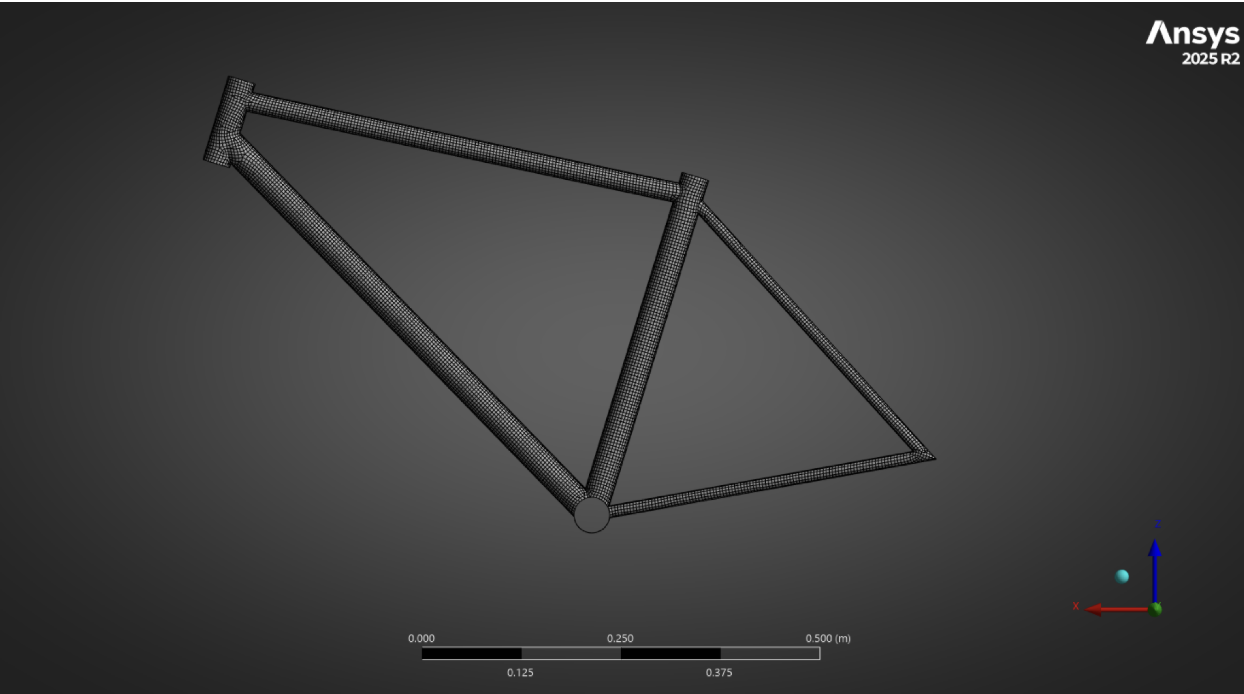
Initial mesh — 4mm shell elements, 6 DOF per node
Results showed maximum deformation of ~0.1mm near the seat and a factor of safety of 15 across most of the frame — confirming the baseline design is structurally over-engineered and a strong candidate for material reduction.
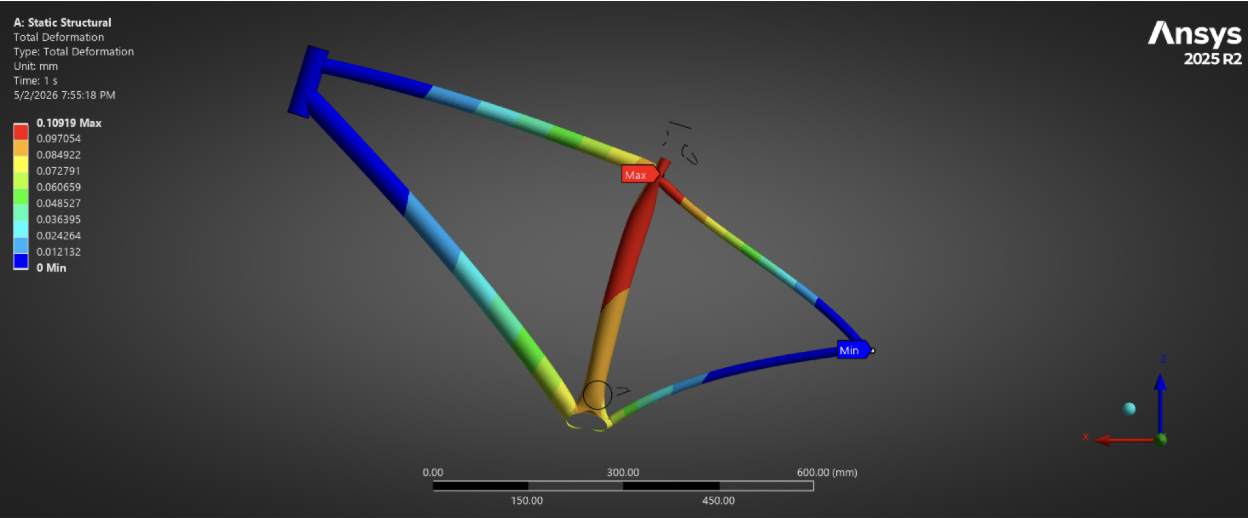
Deformation contour — peak ~0.1mm at seat, confirming baseline over-stiffness
Removed the top tube to cut material, added a battery weight load on the bottom tube to represent realistic e-bike loading conditions, and introduced a hole in the low-stress upper region of the bottom tube. Stress concentration increased slightly around the cutout but remained well within safe limits — demonstrating that stress-map-guided geometry decisions can meaningfully reduce mass without introducing structural risk.
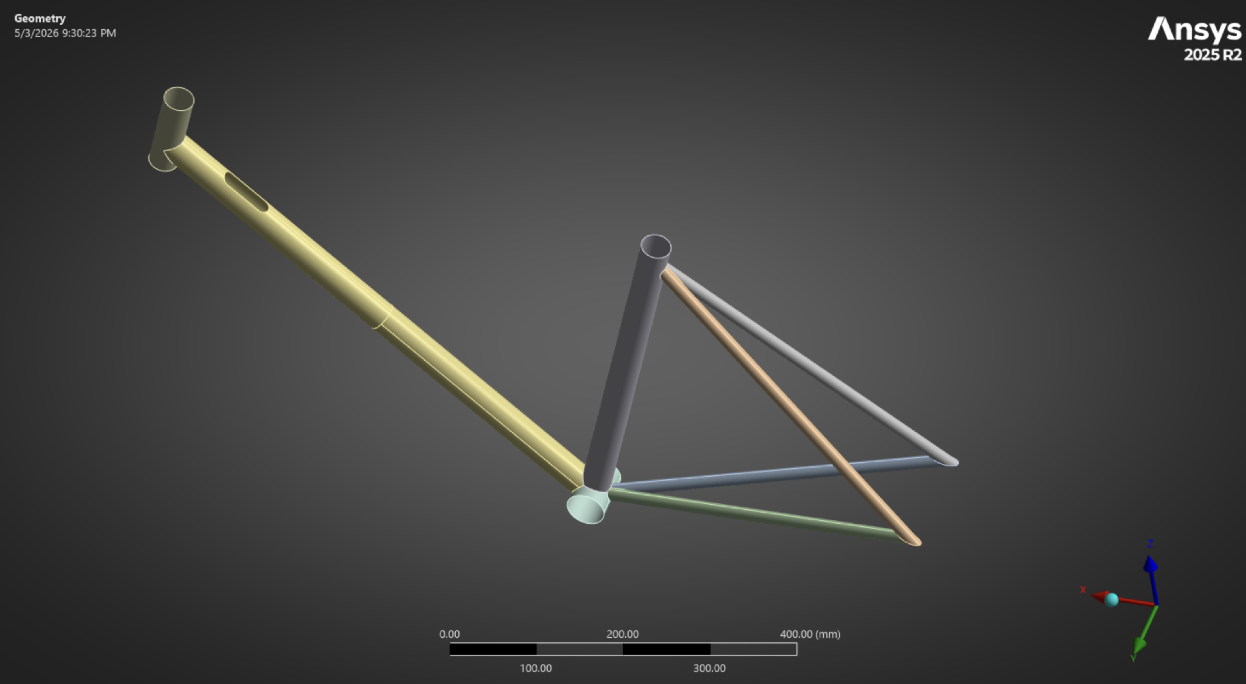
Optimized design — modified design with top tube removed and bottom tube cutout
Configured a parametric sweep of seat tube thickness from 1–2mm, then launched a Response Surface Optimization using the MOGA (Multi-Objective Genetic Algorithm) in Ansys Mechanical. Objective: minimize frame mass while maintaining FOS ≥ 3.5. After 1,511 evaluations the algorithm converged on an optimal thickness of ~1.16mm. Maximum Von-Mises stress at the optimized geometry was ~64 MPa — well below aluminum's yield strength — confirming the result is both safe and material-efficient.
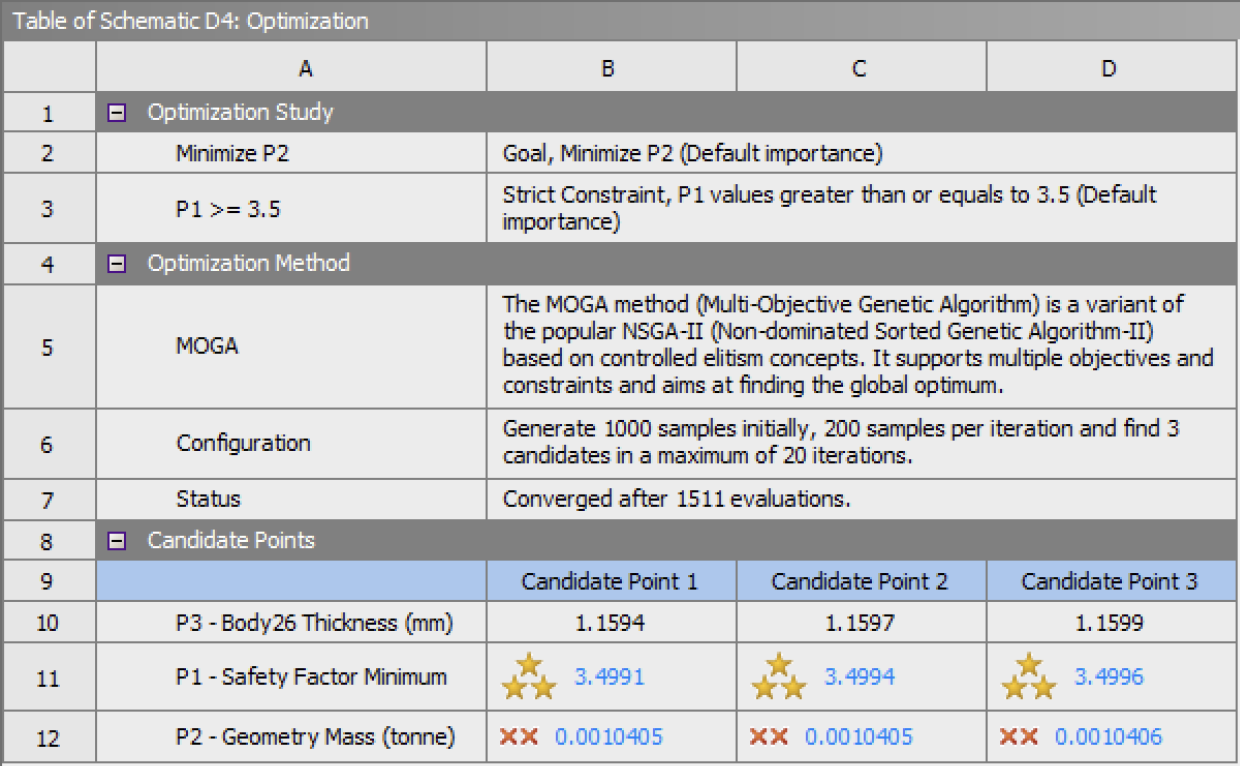
MOGA results — 1,511 evaluations converging on 1.16mm optimal thickness
Outcomes
Key Results
42%
Material Reduction
Lower tube material saved versus the original 2mm baseline design
3.5×
Factor of Safety
Maintained at or above the safety threshold after full optimization
1,511
MOGA Evaluations
Algorithm evaluations to converge on 1.16mm optimal seat tube thickness
Takeaways
What I learned
- Shell-theory FEA fundamentals — what 6-DOF node modeling means for thin-walled structures, and where it's appropriate versus solid elements
- Surface modeling in Fusion 360 — previously only worked with solid bodies; surface tools are essential for shell FEA geometry prep
- Parametric response surface optimization — the full MOGA workflow end-to-end in Ansys Mechanical, from parameter bounds to candidate selection
- Projecting sketches onto curved surfaces to create geometry cutouts in Fusion 360 — a workflow I'll use regularly for complex part features